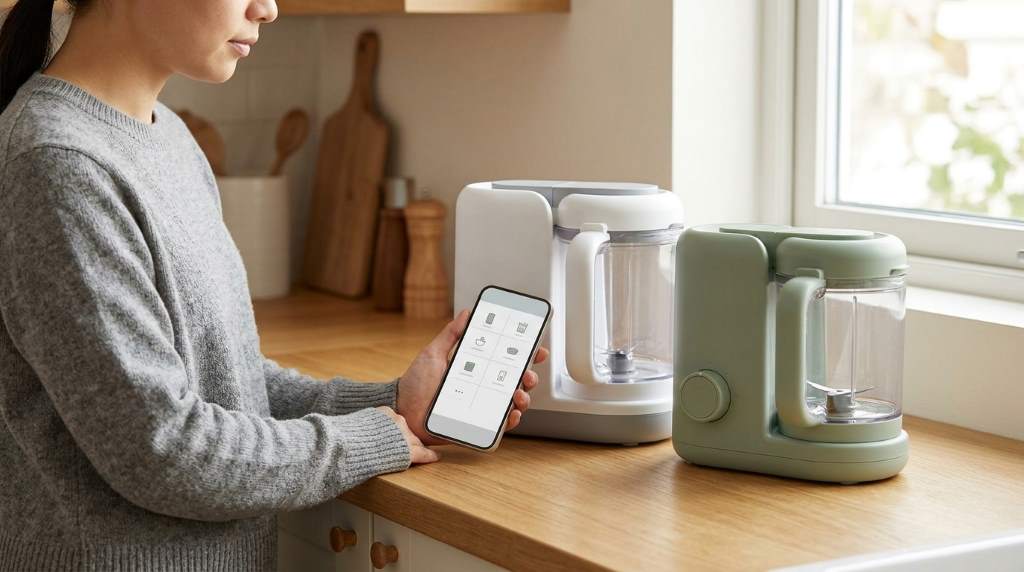
Choose baby food makers by matching steam and blending performance to your baby’s feeding stage and your daily routine. Prioritize safe materials, useful capacity, simple cleaning, texture control, and reliable cooking performance over extra modes. Most babies begin complementary foods around 6 months, while new foods often need 3 to 5 days between introductions.
If you compare baby food makers carefully, you can avoid paying for features you rarely use. The right appliance should make homemade meals easier without creating another complicated kitchen chore.
Key Takeaways
- Choose steam-and-blend models when convenience matters most.
- Match bowl capacity to your actual batch-cooking habits.
- Prioritize texture control because feeding needs change quickly.
- Check every removable part before buying for easier cleaning.
- Look for dependable safety features, not flashy smart functions.
- Consider whether the appliance remains useful beyond smooth purées.
Start With Your Feeding Routine
The best baby food maker depends less on brand reputation and more on how you prepare meals. First, decide whether you make fresh portions daily or freeze several batches.
If you cook small portions frequently, prioritize compact bowls and quick controls. However, batch cooks should choose larger capacities that reduce repeated preparation.
Ask These Questions Before Shopping
- How many portions do you usually prepare at once?
- Do you want steaming and blending in one appliance?
- Will you prepare meat, grains, vegetables, and fruit?
- Do you need smooth and chunky textures from one machine?
- How much counter and cabinet space can you spare?
- Would you use the appliance after the purée stage?
Your answers create a practical buying profile before specifications influence your decision. Consequently, you can compare machines against real needs instead of impressive packaging.
Choose the Right Type of Baby Food Maker
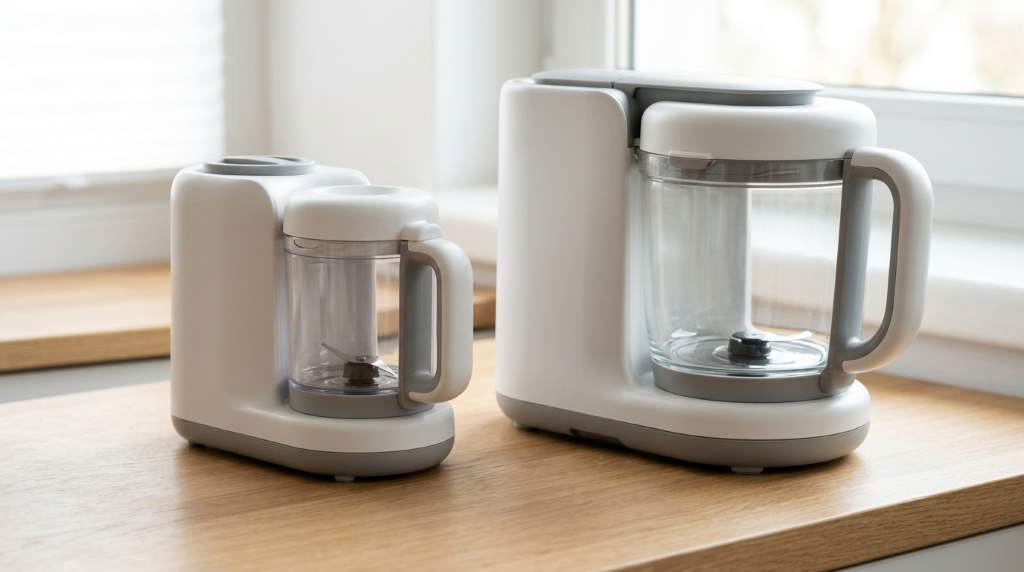
Baby food preparation appliances generally fall into dedicated steam-and-blend machines, baby food processors, and simple blending systems. Each option works well, but each solves a different kitchen problem.
Steam-and-Blend Machines
These appliances combine cooking and blending within one coordinated workflow. They suit parents who value fewer transfers, fewer dishes, and straightforward preparation.
Many models can steam vegetables before blending them into different textures. Therefore, this design works especially well during the early stages of complementary feeding.
Baby Food Processors
Food processors emphasize chopping, blending, mixing, or portion preparation rather than cooking. Choose one when you already have reliable steaming equipment and want stronger processing versatility.
However, you may need another appliance for cooking ingredients until they become soft enough. That extra step can matter when you prepare food frequently.
Standard Blenders or Immersion Blenders
A regular blender can handle baby food effectively when ingredients receive proper cooking first. This approach makes sense if you already own suitable kitchen equipment.
However, standard blenders may struggle with very small portions or thick mixtures. An immersion blender can solve some portion problems while offering useful flexibility later.
Compare Cooking and Blending Performance
Do not treat steaming and blending as identical performance categories. A machine can steam efficiently yet produce inconsistent textures during blending.
Evaluate the Steaming System
Look for consistent steaming, accessible water controls, and clear instructions for different ingredients. Also check whether the reservoir remains easy to clean after repeated use.
Automatic shutoff can add useful protection when water runs low or cooking finishes. Likewise, dry-run protection can reduce risks associated with unattended operation.
Evaluate the Blender
Blade design and motor performance affect how smoothly the machine handles fibrous or dense ingredients. Test specifications matter more when you regularly prepare beans, meats, leafy vegetables, or grains.
Nevertheless, maximum motor power alone does not guarantee better baby food. Bowl shape, blade placement, minimum batch size, and liquid requirements also influence results.
Choose Capacity Based on Portions, Not Marketing
A larger bowl sounds convenient, but capacity only matters when your routine uses it. Conversely, a tiny bowl becomes frustrating when you prepare several meals together.
Estimate your typical weekly preparation before choosing capacity. Then consider whether you refrigerate fresh portions or freeze meals for later.
| Preparation Style | Useful Capacity Priority | Best Feature |
|---|---|---|
| Fresh daily portions | Small to medium | Fast preparation |
| Several portions weekly | Medium to large | Efficient batch cooking |
| Freezer-focused preparation | Large | Higher batch capacity |
| Family meal adaptation | Flexible | Versatile processing |
Also inspect usable capacity rather than advertised maximum capacity. Manufacturers may measure capacity differently, so compare actual working volume whenever possible.
Make Texture Control a Priority
Your baby will not need the same texture throughout the feeding journey. Early foods may require smooth preparation, while developing skills call for thicker and more varied textures.
Choose a machine that lets you control blending duration and consistency. Pulse controls, manual blending, or multiple texture settings can provide useful flexibility.
Avoid choosing a machine that encourages perfectly smooth food indefinitely. Texture progression matters, so your appliance should support changing feeding skills rather than restrict them.
Inspect Cleaning Before Buying
Cleaning often determines whether parents continue making homemade food after the initial excitement fades. Therefore, treat cleanup as a primary specification instead of an afterthought.
Check Every Removable Component
- Blades should detach safely when the design permits removal.
- Seals should remain accessible for thorough cleaning.
- Steam baskets should not trap food residue easily.
- Lids should avoid narrow spaces that collect moisture.
- Dishwasher-safe components can reduce daily workload.
However, dishwasher-safe does not mean every component belongs inside the dishwasher. Always follow the manufacturer’s cleaning instructions for blades, seals, electrical parts, and containers.
Look for Hard-to-Reach Areas
Inspect photos of the bowl, lid, blade housing, and water reservoir closely. Crevices that look harmless can become annoying when food residue accumulates repeatedly.
Likewise, check how easily you can access the steam pathway. Mineral buildup can become troublesome when you use the appliance frequently.
Choose Materials With Practical Safety in Mind
Food-contact materials deserve careful attention because the appliance repeatedly handles ingredients intended for infants. Look for clear material information rather than vague claims about safety.
Glass containers offer a durable option and resist many odors and stains. Plastic containers can provide lighter handling, but verify their food-contact specifications before purchasing.
Also check whether the cooking container handles heat according to the manufacturer’s instructions. Never assume a container remains safe simply because it looks durable.
Prioritize Safety Features That Matter
Good safety design should prevent common mistakes without making ordinary preparation complicated. Look for secure lids, stable bases, automatic shutoff, and overheating protection.
Steam deserves particular attention because hot vapor can cause serious burns. Choose designs that minimize direct exposure when opening the cooking chamber.
Furthermore, avoid overfilling the bowl or blocking steam pathways. Follow recommended water levels and ingredient limits every time you prepare food.
Think Beyond the Purée Stage
A dedicated appliance provides better value when it remains useful as your child’s eating skills develop. Consider whether it can chop, mash, pulse, reheat, or prepare family ingredients later.
This matters because babies gradually move toward thicker, lumpier, finely chopped, and finger-friendly foods. A machine that supports multiple preparation styles can therefore justify its countertop space longer.
Still, do not pay extra for functions you will never use. Long-term value comes from useful versatility, not the highest feature count.
Decide Which Features Deserve Your Money
| Feature | Priority | Why It Matters |
|---|---|---|
| Steam and blend | High | Simplifies frequent preparation |
| Texture control | High | Supports changing feeding stages |
| Dishwasher-safe parts | High | Reduces routine cleanup |
| Appropriate capacity | High | Matches your batch size |
| Automatic programs | Medium | Useful when they simplify real tasks |
| Reheating function | Medium | Helpful for stored homemade food |
| Smart connectivity | Low | Rarely essential for basic preparation |
This approach exposes a common buying mistake: confusing more functions with greater usefulness. Instead, rank every feature according to how often your household will actually use it.
Calculate the Real Cost of Ownership
The purchase price represents only one part of an appliance’s long-term cost. Replacement blades, storage accessories, filters, seals, and other parts can affect value.
Before buying, check whether replacement components remain available. Also investigate warranty coverage, cleaning requirements, and the expected lifespan of frequently handled parts.
A moderately priced machine with accessible replacement parts can outperform an expensive appliance with costly proprietary accessories. Therefore, compare ownership costs rather than comparing sticker prices alone.
Do You Actually Need a Dedicated Baby Food Maker?
No, you do not necessarily need a dedicated appliance to make homemade baby food. A saucepan, steamer basket, food processor, blender, or immersion blender can handle many preparation tasks.
However, a dedicated machine can make sense when convenience drives your decision. If it combines steaming, blending, and manageable cleanup, it can reduce several repetitive steps.
Choose the dedicated option when it removes meaningful work from your routine. Otherwise, using equipment you already own may provide better value.
Common Buying Mistakes to Avoid
- Choosing capacity without considering actual batch sizes.
- Buying powerful motors without checking small-batch performance.
- Ignoring difficult-to-clean seals and steam pathways.
- Paying for connected features you will rarely use.
- Choosing a machine that only produces smooth purées.
- Assuming dishwasher-safe means completely maintenance-free.
- Ignoring replacement parts and warranty conditions.
These mistakes often come from comparing specification lists instead of complete workflows. Instead, imagine preparing one meal from raw ingredients through cleaning.
Use This Five-Minute Buying Test
Before purchasing, mentally walk through your busiest feeding day. Ask whether the machine handles your ingredients, portion size, preferred texture, cooking method, and cleanup routine.
Then score each candidate from one to five across those categories. Eliminate any model that performs poorly in a category you consider essential.
- Cooking: Does it steam ingredients consistently?
- Blending: Does it create the textures you actually need?
- Capacity: Does the working volume fit your routine?
- Cleaning: Can you clean every food-contact surface easily?
- Longevity: Will useful functions remain after the purée stage?
The highest overall score usually matters more than one impressive specification. This method also prevents attractive extras from distracting you from everyday usability.
How to Prepare Baby Food More Efficiently
Once you choose a machine, organize ingredients before starting the appliance. Wash, peel, remove pits or bones, and cut ingredients according to the manufacturer’s preparation guidance.
Cook foods until they become appropriately soft before blending when the appliance requires separate preparation. Then adjust texture gradually rather than automatically producing the smoothest possible purée.
Prepare reasonable portions and store them using safe food-handling practices. Label stored portions with preparation information so older food gets used first.
Food Safety Still Comes First
A high-quality appliance cannot compensate for unsafe food handling. Wash hands, clean food-contact surfaces, cook ingredients appropriately, and prevent cross-contamination during preparation.
Also avoid ingredients unsuitable for young children, including honey before 12 months. Ask your pediatrician about feeding concerns, allergies, developmental readiness, or specialized dietary needs.
Remember that the appliance supports feeding preparation rather than determining what your baby should eat. Your child’s developmental stage should guide texture, portioning, and food choices.
Frequently Asked Questions
What is the most important feature in a baby food maker?
Choose reliable steam-and-blend performance, because it directly reduces preparation steps and supports convenient homemade meals.
Is a baby food maker better than a blender?
It can be more convenient because dedicated models may cook and blend without requiring separate appliances.
What capacity should a baby food maker have?
Choose capacity according to your usual batch size, storage habits, and how frequently you prepare homemade food.
Are dishwasher-safe baby food makers worth choosing?
Yes, dishwasher-safe components can reduce cleanup, but verify which parts actually tolerate dishwasher cleaning.
Can a baby food maker handle chunky textures?
Many models can produce thicker textures, but manual controls and short blending cycles provide better consistency control.
Final Buying Advice
The best baby food maker is the one that fits your cooking routine, feeding stage, kitchen space, and cleaning tolerance. Focus first on safe construction, dependable steaming, texture control, useful capacity, and straightforward maintenance.
Before you buy, compare at least three models using the same checklist. Then choose the appliance that removes the most work without adding unnecessary complexity to your kitchen.
Start with your actual weekly routine today, score your shortlisted machines, and choose the model that solves your biggest preparation problem.