
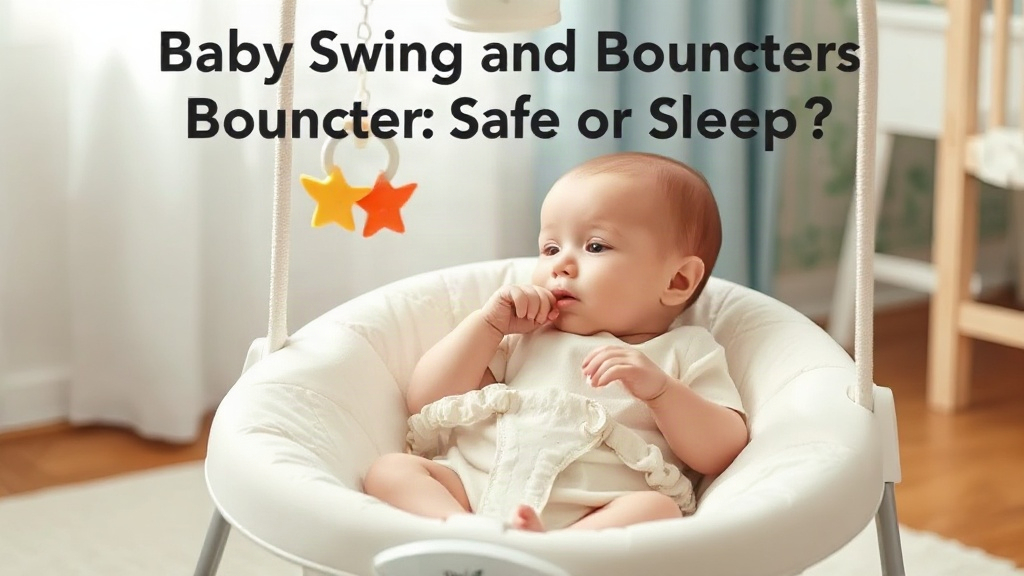
Your baby finally dozed off in the bouncer, and you are eyeing the stairs. Every parent has faced this moment, and the question of Are Baby Swings and Bouncers Safe for Sleep? What Parents Should Know rarely gets a straight answer. The honest answer is simple, and it may surprise you.
Quick answer: No. Swings and bouncers are not safe for sleep, supervised or not. Their angled seats let a baby’s head slump forward, which can block a small airway, and they lack the flat, firm surface that safe sleep requires. Use them only for short, awake, supervised play, then move your baby to a crib, bassinet, or play yard for sleep.
This article explains why the angle matters, how safety guidance from pediatric authorities treats these products, and the habits that let you use them without raising the risk. By the end, you will know exactly when a swing is fine and when your baby needs a firm, flat surface.
What is Are Baby Swings and Bouncers Safe for Sleep? What Parents Should Know?
A baby swing hangs or rocks an angled seat to soothe a fussy infant. A bouncer is a low seat on a springy frame that bounces with your baby’s movement. Both are popular because they calm crying quickly. That soothing effect is real, which is exactly why the sleep question comes up so often.
Why the seat angle is the problem
The American Academy of Pediatrics (AAP) recommends that babies sleep on a firm, flat surface with nothing soft nearby. A swing or bouncer seat sits your baby at an incline. On that slope, a newborn’s heavy head can tip chin-to-chest. A floppy airway plus a slumped neck can reduce oxygen intake, and a baby lacks the neck control to fix it.
That risk is why the AAP advises against routine sleep in swings, bouncers, car seats, and similar products. This advice covers supervised sleep too. Head-slump can happen within minutes, even while you are in the room.
Product labels matter. Many swings and bouncers carry warnings against sleep use. Read the manual before you buy, and check the weight limit as your baby grows.
What the products are actually for
Think of these seats as awake-time tools, not furniture. A bouncer gives you a safe spot to set your baby down while you fold laundry two feet away. A swing can settle a colicky infant during a fussy evening stretch. Neither is designed to hold a sleeping baby for hours.
Newborns sleep 14 to 17 hours a day in the first months. Most of that belongs on a flat, firm mattress with a fitted sheet.
The word “safe” in product marketing often means “won’t tip over.” It does not mean “approved for infant sleep.” Those are two very different claims.
When parents ask about overnight use
Some babies seem to sleep longer in a swing, especially babies with reflux or colic. The temptation to leave them there overnight is strong. Resist it. Overnight sleep means hours without direct supervision, and a slumped head can go unnoticed. If your baby struggles to settle flat, talk to your pediatrician about options such as a swaddle or a bassinet with a slight leg elevation, rather than relying on an angled seat.
Takeaway: Swings and bouncers are awake-time seats, not sleep spaces. The incline that soothes your baby is the same feature that makes sleep there risky.
Why Are Baby Swings and Bouncers Safe for Sleep? What Parents Should Know matters
The stakes are high because infant sleep safety rules exist for a reason. Sudden unexpected infant death, including sleep-related suffocation, remains a leading cause of infant mortality in the United States. Safe sleep guidance from pediatric authorities targets exactly these preventable scenarios.
The airway mechanics in plain terms
Picture a newborn’s neck. The muscles are weak, and the head is proportionally large and heavy. Lay that baby on a 30-degree incline and gravity pulls the chin toward the chest. The windpipe is soft cartilage, so it can narrow. A flat mattress keeps the head neutral, so the airway stays open.
The fall and tip-over risk
A bouncer placed on a bed or sofa is a well-documented hazard. Babies wiggle, and frames slide. A fall from couch height onto a hard floor can cause serious head injury. Swings carry their own tipping risk if a toddler sibling leans on the frame. Keeping these seats on the floor, away from stairs and pets, reduces that danger.
Parents need sleep too
Exhaustion pushes good parents toward shortcuts. A 2 a.m. decision to let the baby finish the night in the swing feels harmless in the moment. Knowing the reason behind the rule helps you plan. Set up a safe sleep space in every room where your baby naps: a bassinet in the bedroom, a play yard in the living room, a firm cot at grandma’s house.
Comparison: swing versus crib for a nap
| Feature | Swing or bouncer | Crib or bassinet |
|---|---|---|
| Surface | Angled, padded | Flat, firm |
| Head position | Can slump forward | Neutral |
| Supervision needed | Constant | Routine checks |
| Safe for overnight | No | Yes |
Notice the pattern: every row favors the flat surface for sleep. The swing wins on soothing, not on safety.
Never place a bouncer on a bed, sofa, or counter. Falls from height are a leading injury risk for babies in these seats.
Takeaway: Safe sleep rules are not bureaucracy. They map directly onto how a baby’s airway and body work in the first year.
Best practices
You do not have to give up your swing. You need clear rules for using it. These habits keep the seat useful and your baby safer.
Follow the four-part check every time
Run through this routine before your baby settles into any swing or bouncer:
- Awake and supervised. Use the seat only while your baby is awake, and stay within arm’s reach.
- Floor level. Set it on a flat, stable floor, never on furniture.
- Buckle up. Use the harness every time, even for a 30-second pause.
- Time limit. Keep sessions short, roughly 30 minutes or less, and move your baby if they fall asleep.
Transfer a sleeping baby promptly
If your baby nods off in the swing, move them to a flat surface right away. The transfer takes seconds and removes the risk. Some parents keep a bassinet near the kitchen for exactly this reason.
Respect the weight and age limits
Most bouncers top out around 20 to 25 pounds, and swings vary by model. A baby who can sit up or roll may try to climb out. Retire the seat when your baby hits either limit.
A wearable baby carrier is a safe alternative when your baby wants to be held, and you need your hands. It keeps your baby upright and close without an angled seat.
Build a safe-sleep-friendly routine
Use the swing as a wind-down step, not a destination. Rock for ten minutes during the drowsy phase, then transfer to the crib. This teaches your baby that the flat surface is where sleep happens.
Check for recalls and secondhand wear
If you buy used, check the model number against recall lists from the Consumer Product Safety Commission. Look for frayed straps, a cracked frame, or missing buckles. A damaged harness defeats the purpose of buckling up.
Takeaway: Short, supervised, floor-level sessions with a prompt transfer cover almost every safety concern parents raise.
Common mistakes to avoid
Most swing-related scares trace back to a handful of habits. Recognizing them makes them easier to catch in yourself and in caregivers.
Letting the swing become the crib
It starts innocently: one long nap, then a whole night. This is the most common mistake, and the most serious. Overnight use removes the supervision that makes short sessions acceptable. Break the pattern early by offering every nap in the crib from the first week home.
Adding blankets and pillows
Parents sometimes tuck a blanket around a baby in a bouncer to keep them warm. Soft bedding near a sleeping infant’s face raises suffocation risk. Dress your baby in a sleeper instead, and keep the seat bare.
Skipping the harness
A wiggly baby can slide forward in seconds. The harness is not optional. Buckle it snugly every time, including for the “quick” set-down while you answer the door.
Leaving older siblings in charge
A four-year-old cannot monitor an airway. Supervised means an adult, or a responsible caregiver old enough to act if something looks wrong.
Ignoring the drowsy-but-awake window
Placing a fully asleep baby into a swing and walking away is the exact scenario the warnings target. Use the seat for soothing, then move your baby while they are still drowsy.
Assuming “supervised” erases the risk
The incline risk exists even with you in the room. Supervision helps with falls and siblings. It does not keep a slumped airway open.
A swing used briefly, on the floor, buckled, and followed by a prompt transfer is a reasonable parenting tool. A swing used as a bed is a genuine hazard.
Takeaway: The biggest mistake is drift. Safe habits erode one tired night at a time, so set your rules now and share them with every caregiver.
FAQ
Can my baby sleep in a swing if I watch them the whole time?
No. The incline can cause head-slump and airway narrowing even when you are nearby. Supervision does not fix the angle. Move your baby to a flat, firm surface as soon as they fall asleep.
At what age can a baby safely sleep in a bouncer?
No age makes a bouncer safe for sleep. The risk comes from the angle and soft surfaces, which do not change as your baby grows. Retire the bouncer when your baby reaches the weight limit or starts sitting up.
What should I do if my baby only sleeps in the swing?
Try a consistent flat-sleep routine first, and ask your pediatrician about persistent settling problems. Reflux and colic have safer solutions than overnight swing use. A bassinet beside your bed often helps babies adjust gradually.
Are inclined sleepers and swings the same thing?
They share the same flaw. Inclined sleepers were largely removed from the market after safety concerns. Swings and bouncers remain soothing products, but they are not approved sleep spaces.
Is a bouncer safe for a newborn during awake time?
Yes, for short stretches. Keep your baby buckled, on the floor, and within reach. Watch for signs of sleepiness and transfer them promptly.
Conclusion
The short answer to Are Baby Swings and Bouncers Safe for Sleep? What Parents Should Know is a firm no. Swings and bouncers soothe babies, but their angled seats and soft padding make them unsafe for naps or nights. Use them for brief, supervised, buckled awake time, and always move a sleeping baby to a crib, bassinet, or play yard.
Your next step is a practical one. Pick the room where your baby spends the most daytime hours and set up a flat, safe sleep spot within arm’s reach of where you sit. Then tell every caregiver the same rule: swing for soothing, crib for sleep.


